Diana
at the Château de Chenonceau
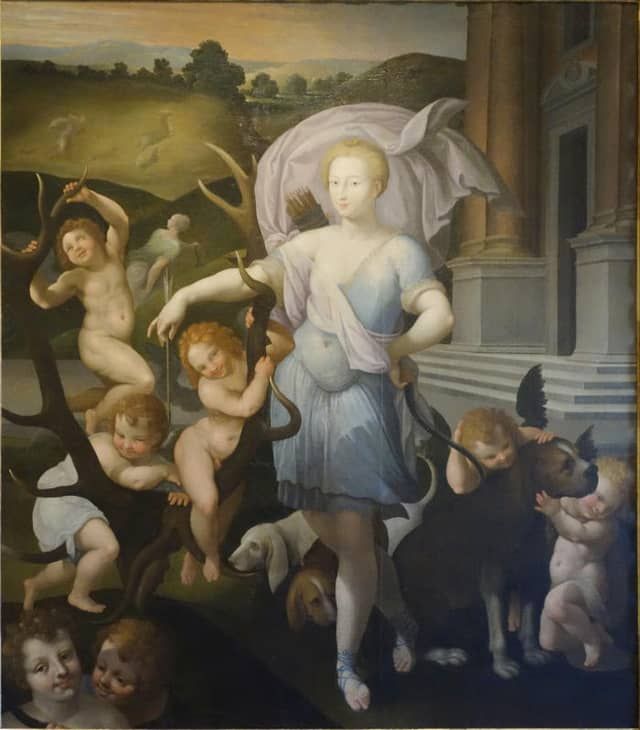
“They say Diana the Quiver-bearer’s anger was not appeased, until his life had ended in innumerable wounds”. “The Metamorphoses”, Book III, verses 251 to 252.
This portrait is a work by Primaticcio (opens in a new tab), a painter from Bologna, Italy, invited by King Francis I (opens in a new tab) and later almost a minister of Culture of the time, who painted it, in , at the Château de Chenonceau (opens in a new tab).
In France, he was known at the time by the French form of his name, Le Primatice.
The image represents the favourite of King Henry II (opens in a new tab), the son who succeeded Francis I: Diane de Poitiers (opens in a new tab).
At the French royal court of the time, she was known for her exceptional beauty.
At the time, there was a fashion for the parallel portrait: here, the person is not represented directly, but as the goddess of the hunt who shares the same name, Diana (opens in a new tab).
The story below, in which Diana, goddess of the Hunt, encounters the hunter Actæon, was written by a writer of the Roman imperial era, Ovid (opens in a new tab). It is taken from his work “The Metamorphoses (opens in a new tab)”.
In “The Metamorphoses”, Diana, daughter of Latona and twin sister of Apollo, appears in several stories, almost always as a chaste goddess quick to punish. In Book II, she drives the nymph Callisto, seduced by Jupiter, out of her band; in Book III comes the story of Actæon, quoted below; in Book V, she hides the nymph Arethusa from the river Alpheus, who is pursuing her, and Arethusa becomes a spring; in Book VI, with Apollo, she avenges the insult done to their mother by Niobe, killing her children; in Book VIII, she sends a monstrous boar against Calydon, because King Oeneus has forgotten her in his offerings; in Book XI, she pierces with an arrow the tongue of Chione, who had boasted of being more beautiful than she; in Book XII, at Aulis, she accepts a hind in place of Iphigenia; and in Book XV, she hides Hippolytus, brought back to life, under the features of Virbius.
May this tale of the goddess of the Hunt and Actæon’s adventure please you!
Diana and Actæon according to the text of Book III of “The Metamorphoses”
131 Now Thebes stands, and now you might be seen
as happy, in your exile, Cadmus. You have Mars and Venus as your bride’s parents,
and added to this the children of so noble a wife,
so many sons and daughters, and dearly loved descendants,
135 your grandchildren, who now are young men. But in truth we should always
wait for a man’s last day, for that time when he has paid his last debt,
and we should call no man’s life happy until he is dead.
Actæon, one of your grandsons, was your first reason for grief,
in all your happiness, Cadmus. Strange horns appeared
140 on his forehead, and his hunting dogs sated themselves on the blood of their master.
But if you look carefully, you will find that it was the fault of chance
and not wickedness: what wickedness is there in error?
It happened on a mountain, stained with the blood of many creatures,
and midday had contracted every shadow
145 and the sun was equidistant from either end of his journey.
Then Actæon, the young Boeotian, with a quiet expression, spoke to his companions
in the hunt as they wandered through the solitary wilds:
“Friends, our spears and nets are drenched with the blood of our victims,
and the day has been fortunate enough.150
When Aurora in her golden chariot brings another day
we will resume our purpose. Now Phoebus is also
between the limits of his task, and is splitting open the earth with his heat.
Finish your present task and carry home the netted meshes”.The men obeyed his order and left off their labour.
155 There was a valley there called Gargaphie,
dense with pine trees and sharp cypresses, sacred to Diana of the high-girded tunic,
where, in the depths, there is a wooded cave,
not fashioned by art.
But ingenious nature had imitated art.
160 She had made a natural arch out of native pumice and porous tufa.
On the right, a spring of bright clear water murmured
into a widening pool, enclosed by grassy banks.
Here the woodland goddess, weary from the chase,
would bathe her virgin limbs in the crystal liquid.
165 Having reached the place, she gives to one of the nymphs, her weapon-bearer,
her spear, quiver and unstrung bow.
Another takes her robe over her arm,
while two unfasten the sandals on her feet. Then, more skilful than the rest,
Theban Crocale gathers the hair strewn
170 around her neck into a knot, while her own is still loose.
Nephele, Hyale, Rhanis, Psecas and Phiale
draw water, and pour it over their mistress out of the deep jars.
While Titania is bathing there, in her accustomed place,
Cadmus’s grandson, free of his share of the labour,
175 strays with aimless steps through the strange wood,
and enters the sacred grove. So the fates would have it.
As soon as he reaches the cave mouth dampened by the fountain,
the naked nymphs, seeing a man’s face,
beat at their breasts and filling the whole wood
180 with their sudden outcry, crowd round Diana
to hide her with their bodies. But the goddess
stood head and shoulders above all the others.
185 Diana’s face, seen there, while she herself was naked, was the colour of clouds stained by the opposing shafts of sun, or Aurora’s brightness.
However, though her band of nymphs gathered in confusion around her,
she stood turning to one side, and looking back,
and wishing she had her arrows to hand.
She caught up a handful of the water that she did have, and threw it in the man’s face.
190 And as she sprinkled his hair with the vengeful drops
she added these words, harbingers of his coming ruin:
“Now you may tell of having seen me naked,
if you can tell that is”! Without more threats, she gavethe horns of a mature stag to the head she had sprinkled,
195 lengthening his neck, making his ear-tips pointed,
changing feet for hands, long legs for arms,
and covering his body with a dappled hide.
And then she added fear. Autonoë’s brave son flies off,
marvelling at such swift speed, within himself.
200 But when he sees his head and horns reflected for certain in the water,
he tries to say:
“Oh, look at me”! but no voice follows.He groans: that is his voice, and tears run
down his altered face. Only his mind remains unchanged.
What can he do? Shall he return to his home and the royal palace,
205 or lie hidden in the woods? Shame prevents the one, and fear the other.
While he hesitates his dogs catch sight of him. First ‘Black-foot’, Melampus,
and keen-scented Ichnobates, ‘Tracker’, signal him with baying,
Ichnobates out of Crete, Melampus, Sparta.
Then others rush at him swift as the wind,
210 ‘Greedy’, Pamphagus, Dorceus, ‘Gazelle’, Oribasos, ‘Mountaineer’, all out of Arcady:
powerful ‘Deerslayer’, Nebrophonos, savage Theron, ‘Whirlwind’, and Laelape, ‘Hunter’.
Then swift-footed Pterelas, ‘Wings’, and trail-scenting Agre, ‘Chaser’,
fierce Hylaeus, ‘Woody’, lately gored by a boar,
the wolf-born Nape, ‘Valley’, Poemenis, the trusty ‘Shepherd’, and
215 Harpyia, ‘Snatcher’, with her two pups.
There is thin-flanked Sicyonian Ladon, ‘Catcher’,
Dromas, ‘Runner’, ‘Grinder’, Canache, Sticte ‘Spot’, Tigris ‘Tigress’, Alce, ‘Strong’,
and white-haired Leucon, ‘Whitey’, and black-haired Asbolus, ‘Soot’.
Lacon, ‘Spartan’, follows them, a dog well known for his strength, and strong-running Aëllo, ‘Storm’.
220 Then Thoos, ‘Swift’, and speedy Lycisce, ‘Wolf’, with her brother Cyprius ‘Cyprian’.
Next ‘Grasper’, Harpalos, with a distinguishing mark of white, in the centre of his black forehead,
‘Black’, Melaneus, and Lachne, ‘Shaggy’, with hairy pelt,
Labros, ‘Fury’, and Argiodus, ‘White-tooth’, born of a Cretan sire
and Spartan dam, keen-voiced Hylactor, ‘Barker’,
225 and others there is no need to name. The pack of them,
greedy for the prey follow over cliffs and crags,
and inaccessible rocks, where the way is hard or there is no way at all.
He runs, over the places where he has often chased,
flying, alas, from his own hounds. He longs to shout:
230
“I amActæon! Know your own master”!but words fail him, the air echoes to the baying.
First ‘Black-hair’, Melanchaetes, wounds his back,
then ‘Killer’, Theridamas, and Oresitrophos, the ‘Climber’,
clings to his shoulder.
They had set out late but outflanked the route by a shortcut
235 over the mountains. While they hold their master
the whole pack gathers and they sink their teeth in his body
till there is no place left to wound him. He groans and makes a noise,
not human, but still not one
a deer could make, and fills familiar heights with mournful cries.
240 And on his knees, like a suppliant begging,
he turns his wordless head from side to side, as if he were stretching arms out towards them.
Now his friends, unknowingly, urge the ravening crowd of dogs on
with their usual cries, looking out for Actæon,
and shouting, in emulation, for absent Actæon
245 (he turning his head at the sound of his name) complaining he is not there,
and through his slowness is missing the spectacle offered by their prey.
He might wish to be absent it’s true, but he is here:
he might wish to see and not feel the fierce doings of his own hounds.
They surround him on every side, sinking their jaws into his flesh,
250 tearing their master to pieces in the deceptive shape of the deer.
They say Diana the Quiver-bearer’s anger was not appeased, until his life had ended in innumerable wounds.