Adonis
at the Château de Cheverny
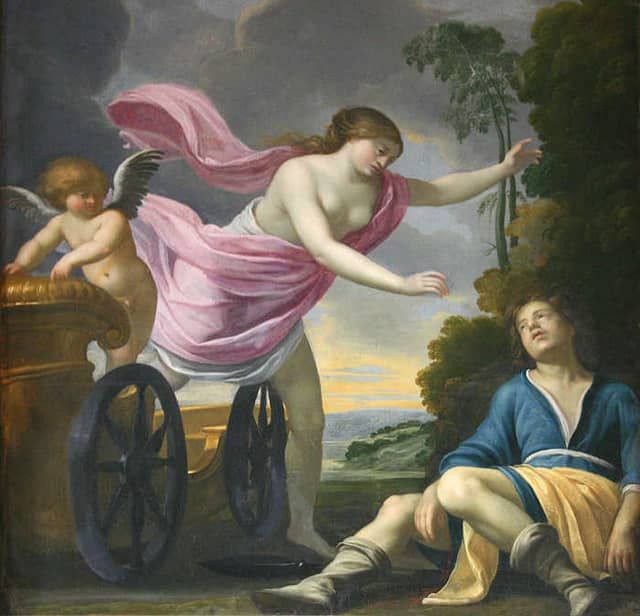
“saw the lifeless body, lying in its own blood, she leapt down”: Adonis, whom she mourns, has just been killed by a wild boar. “The Metamorphoses”, Book X, verses 720 to 722.
There is a short text at the origin of the painting “The Death of Adonis”, made by Jean MONIER (opens in a new tab) during the s to hang above a fireplace and displayed on the first floor of the Château de Cheverny (opens in a new tab).
This text was written by Ovid (opens in a new tab), a Latin writer who lived under the Roman Empire, and is part of Book X of his best-known work, “The Metamorphoses (opens in a new tab)”.
It is Orpheus who sings the story of Adonis. Myrrha, in love with her own father Cinyras, was changed into a myrrh tree; the child is born from its bark, so beautiful that he might be taken for one of the Cupids painted in pictures. Grown into a young man, he wins the heart of Venus: grazed by an arrow of her son Cupid, the goddess forsakes her sanctuaries to follow him in the hunt. It is not he who conquers her; it is she who chooses him. She warns him against the beasts that stand and fight, boars and lions, and tells him the story of Atalanta and Hippomenes, turned into lions for offending the gods. Adonis does not heed the warning. His death and his change into the anemone, a short-lived flower, make him the figure of a beauty that does not last, and of Venus's grief a rite renewed every year.
The quoted passage tells the tragic end of Adonis (opens in a new tab), loved by Venus (opens in a new tab).
Here it is below.
the “Death of Adonis” according to the text of Book X of “The Metamorphoses”
708 She warned him, and made her way through the air, drawn by harnessed
swans, but his courage defied the warning.
710 By chance, his dogs, following a well-marked trail, roused a wild boar from its lair, and as it prepared to rush from the trees, Cinyras’s grandson caught it a glancing blow.
Immediately the fierce boar, with its crooked snout,
dislodged the blood-stained spear, and chased the youth, who was scared
715 and running hard. It sank its tusk into his groin,
and flung him, dying, on the yellow sand.
717 Cytherea, carried in her light chariot through the midst of the heavens,
by her swans’ swiftness, had not yet reached Cyprus:
she heard from afar the groans of the dying boy, and turned towards him
720 the white birds. When, from the heights, she saw
the lifeless body, lying in its own blood,
she leapt down, tearing
her clothes, and tearing at her hair, as well, and beat at her breasts with fierce hands,
complaining to the fates, she said:
“And yet not everything725
is in your power. There shall be a token of my grief,
everlasting,Adonis, and an imitation of your death,
every year, will complete a re-enactment of my mourning.
But your blood will be changed into a flower. Persephone, you were allowed
to alter a woman’s body to fragrant mint:730
shall I be grudged the transformation of my hero,
of the blood of Cinyras”? So saying, she sprinkled with odorous nectarthe blood: and, at the touch, it swelled up,
as there rise, on the surface of yellow mud,
transparent bubbles. In less than an hour,
735 a flower, of the colour of blood, was created
such as pomegranates carry, that hide their seeds
under a tough rind. But enjoyment of it is brief;
for, lightly clinging, and too easily fallen,
739 the winds deflower it, which are likewise responsible for its name, windflower: anemone.