Perseus
at the Château de Cheverny
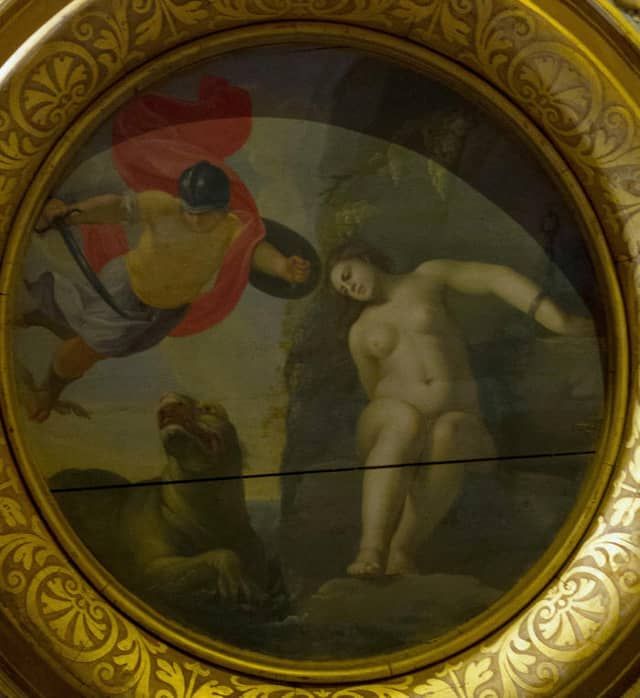
“in swift flight,”through empty space, helps Andromeda chained to a rock. “The Metamorphoses”, Book IV, verse 718.
There is a short text at the origin of “Perseus (opens in a new tab) and Andromeda (opens in a new tab)”, one of the paintings made by Jean MONIER (opens in a new tab) for the ceiling of the King's bedroom, on the first floor of the Château de Cheverny (opens in a new tab), which tell the life of Perseus, a hero of Greek mythology.
It was written by Ovid (opens in a new tab), a Latin writer who lived under the Roman Empire, and is part of Book IV of his best-known work, “The Metamorphoses (opens in a new tab)”.
In the “Metamorphoses”, the story of Perseus fills the end of Book IV and the beginning of Book V: Son of Jupiter and Danaë, whom the god made a mother in the form of a shower of gold, Perseus is returning from his victory over the Gorgon Medusa, whose head he carries: over Libya, the drops of blood falling from it turn into snakes; then he changes the giant Atlas into a mountain by showing him that petrifying face. After freeing Andromeda and marrying her, he tells at the banquet how he overcame Medusa; in Book V, Phineus, Cepheus's brother, to whom Andromeda had been promised, disrupts the feast by force of arms, and Perseus turns him and his companions to stone.
The passage quoted below begins as Perseus, passing unexpectedly through the sky of Ethiopia (opens in a new tab), is astonished to find a naked young girl chained to a rock… It is Andromeda (opens in a new tab).
“Perseus and Andromeda” according to the text of Book IV of “The Metamorphoses”
663 Aeolus, son of Hippotas, had confined the winds in their prison under Mount Etna,
and Lucifer, who exhorts us to work, shone brightest of all
665 in the depths of the eastern sky. Perseus strapped the winged sandals he had put to one side
to his feet, armed himself with his curved sword,
and cut through the clear air on beating pinions.
Leaving innumerable nations behind, below and around him,
he came in sight of the Ethiopian peoples, and the fields of Cepheus.
670 There Jupiter Ammon had unjustly ordered the innocent Andromeda
to pay the penalty for her mother Cassiopeia’s words.
As soon as Perseus, great-grandson of Abas, saw her fastened by her arms
to the hard rock - except that a light breeze stirred her hair,
and warm tears ran from her eyes -
675 he would have thought she was a marble statue. He took fire
without knowing it and was stunned, and seized by the vision of the form he saw,
he almost forgot to flicker his wings in the air.
As soon as he had touched down, he said:
“O, you do not deserve these chains,
but those that link ardent lovers together.680
Tell me your name, I wish to know it, and the name of your country,
and why you are wearing these fetters”. At first she was silent: a virgin, she did not dareto address a man, and she would have hidden with her hands
her face modestly, if they had not been fastened behind her.
She used her eyes instead, and they filled with welling tears.
685 At his repeated insistence, so as not to seem
to be acknowledging a fault of her own, she told him the name of her country
and her name, and what faith her mother had had in her own beauty.
Before she had finished speaking, all the waves resounded,
and a monster menaced them, rising from the deep sea,
690 and covered the wide waters with its breadth.
The girl cried out: her grieving father and mother were together nearby,
both wretched, but the mother more justifiably so.
They bring no help with them, only weeping and lamentations
to suit the moment, and cling to her fettered body.
695 Then the stranger speaks:
“There will be plenty of time left for tears,
but only a brief hour is given us to work.
If I asked for this girl as Perseus, son of Jupiter and that Danaë,
imprisoned in the brazen tower, whom Jupiter filled with his rich golden shower;
Perseus conqueror of the Gorgon with snakes for hair,700
he who dared to fly, driven through the air,
on soaring wings, then surely I should be preferred to all other suitors as a son-in-law.
If the gods favour me, I will try to add further merit to these great gifts.
I will make a bargain. Rescued by my courage, she must be mine”.Her parents accept the contract (who would hesitate?) and, entreating him,
705 promise a kingdom, as well, for a dowry.
See how, like a fast ship with pointed prow
ploughing the water, driven by the sweat-covered muscles of her crew,
the creature comes, parting the waves with surging breast.
It was as far from the rock as a Balearic sling
710 can send a lead shot through the air,
when suddenly the young hero, pushing his feet hard against the earth,
shot high among the clouds. When the shadow of a man appeared
on the water’ surface, the creature raged against the shadow it had seen.
As Jupiter’s eagle, when it sees a snake, in an open field,
715 showing its livid body to the sun,
takes it from behind and, lest it twists back its cruel fangs,
fixes its eager talons in the scaly neck,
so the descendant of Inachus hurling himself headlong, in swift flight,
through empty space, attacked the creature’s back, and, as it roared,
720 buried his sword, to the end of the curved blade, in the right side of its neck.
Hurt by the deep wound, now it reared high in the air,
now it dived underwater, or turned now, like a fierce wild boar,
when the dogs scare him, and the pack is baying around him.
Perseus evades the eager jaws on swift wings,
725 and wherever the monster is exposed, now at the back encrusted with barnacles,
now at the sides of the body, now where the tail is slenderest,
ending fishlike, strikes with his curved sword.
The beast vomits seawater mixed with purplish blood.
The pinions grow heavy, soaked with spray.
730 Not daring to trust his drenched wings any further,
he sees a rock whose highest point stands above quiet water,
hidden by rough seas.
Resting there, and holding on to the topmost pinnacle with his left hand,
he drives his sword in three or four times, repeatedly.
735 The shores, and the high places of the gods, fill with the clamour of applause. Cassiope and Cepheus
rejoice, and greet their son-in-law, acknowledging him as the pillar of their house,
and their deliverer. Released from her chains,
the girl comes forward, the prize and the cause of his efforts.
740 He washes his hands after the victory in seawater drawn for him
and, so that Medusa’s head, covered with its snakes, is not bruised by the harsh sand,
he makes the ground soft with leaves, spreads out plants from below the waves
and places the head of that daughter of Phorcys on them.
The fresh plants, still living inside, and absorbent,
745 respond to the influence of the Gorgon’s head, and harden at its touch,
acquiring a new rigidity in branches and fronds.
And the ocean nymphs try out this wonder
on more plants, and are delighted that the same thing happens at its touch,
and repeat it by scattering the seeds from the plants through the waves.
750 Even now corals have the same nature,
hardening at a touch of air, and what was alive, under the water,
above water is turned to stone.
To the three gods, he builds the same number of altars out of turf,
to you Mercury on the left, to you Minerva, warlike virgin, on the right,
755 and an altar of Jupiter in the centre. He sacrifices a cow to Minerva,
a calf to the wing-footed god, and a bull to you, greatest of the gods.
Then he claims Andromeda, valuing her as the worthiest prize,
without a dowry. Hymen and Amor
wave the marriage torch, the fires are saturated with strong perfumes,
760 garlands hang from the rafters, and everywhere flutes
and pipes, and singing, sound out, the happy evidence
of joyful hearts. The doors fold back to show
the whole of the golden hall, and the noble Ethiopian princes enter
to a richly prepared banquet already set out for them.